The Shock and Awe of History: How 168 Men Destroyed the Mighty Inca Empire

Imagine an empire so vast that it stretched across modern-day Peru, Ecuador, Bolivia, Chile, Colombia, and Argentina. A highly developed civilization of over 10 million people, speaking dozens of languages, navigating complex mountain terrains, and hoarding unimaginable wealth.

Now, imagine that entire empire being brought to its knees by a tiny group of just 168 Spanish fighters.

It sounds like a fictional movie script, but it is one of the most staggering, brutal facts of human history. The fall of the Inca Empire is a masterclass in military technology, psychological warfare, and catastrophic political timing. Here is exactly how it happened.


1. A House Divided: The Inca Civil War

The Spanish did not conquer a stable empire; they walked into a nation bleeding from self-inflicted wounds.

In 1527, the Inca Emperor and his chosen heir both died suddenly from a mysterious illness (likely smallpox, which had begun spreading ahead of the Europeans). This triggered a catastrophic civil war between two royal brothers: Huáscar in the south and Atahualpa in the north.

After years of bloody conflict, Atahualpa finally won, capturing his brother and claiming the throne. But just as he was celebrating his victory, word reached him that a strange group of pale, bearded foreigners had landed on the coast.


2. Enter Francisco Pizarro: Driven by Envy

The leader of these foreigners was Francisco Pizarro, a Spanish conquistador. Pizarro wasn’t just looking for wealth; he was looking for fame. His cousin, Hernán Cortés, had recently conquered the Aztec Empire, becoming a legendary hero in Spain. Desperate to outdo his cousin, Pizarro secured financial backing from King Charles I of Spain for a high-stakes gamble into uncharted South American territory.

On his third expedition, Pizarro marched his small band of 168 men directly into the Andean highlands toward the city of Cajamarca, where the victorious Inca Emperor, Atahualpa, was currently resting.

3. The Fatal Meeting at Cajamarca (1532)

Atahualpa knew the Spanish were coming, but he wasn’t worried. Why would he be? He was surrounded by a battle-tested imperial army of tens of thousands. To him, 168 men were a minor curiosity, not a threat.

On November 15, 1532, Pizarro arrived in the city square of Cajamarca and sent an envoy on horseback to request a meeting. The Incas had never seen horses before-animals that had been extinct in the Americas for 10,000 years. The Spanish messenger rode furiously toward Atahualpa, stopping the massive beast inches from the emperor’s face to terrify him. While his attendants panicked, Atahualpa sat entirely motionless, refusing to show fear. He agreed to meet Pizarro the next day.

It was a fatal mistake. Pizarro spent the night hiding his men, his cavalry, and four small cannons inside the buildings surrounding the open courtyard.

4. The Trap: A Bible and a Bloodbath

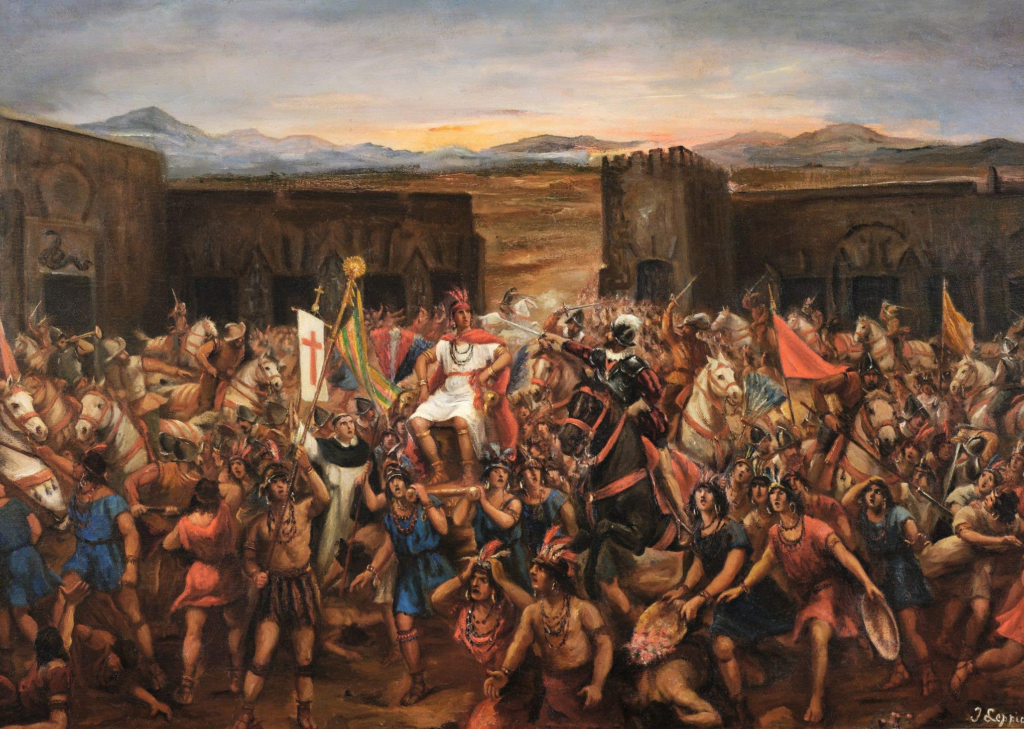
On the evening of November 16, Atahualpa entered the square on a golden litter, surrounded by thousands of his top nobles and citizens. Because this was a peaceful meeting, his guard carried only ceremonial, hidden weapons. They expected a diplomatic talk; they walked into a slaughterhouse.

A Spanish priest stepped forward, holding a Christian Bible, and began speaking to the Emperor about a foreign god. Having no concept of a written book or a printing system, Atahualpa examined the object briefly before tossing it to the ground.

Pizarro used this moment of “sacrilege” as the ultimate trigger. He ordered his men to attack.

The Tactics of “Shock and Awe

  • The Cannons Roared: The sudden, deafening explosions of hidden cannons ripped through the crowd. The Incas had never heard gunpowder before-it sounded like the sky was collapsing.
  • The Armored Monsters Charged: Steel-clad Spanish riders burst from the buildings on horseback. To the terrified Incas, the armor-clad rider and the horse looked like a single, unstoppable, mythological monster.
  • The Steel Sliced: The Incas fought back bravely with their hands and wooden clubs, but they were utterly useless against Spanish steel swords and metal breastplates.

Within a few hours, the 168 Spanish soldiers slaughtered thousands of Inca nobles without losing a single Spanish life. By nightfall, Emperor Atahualpa was a prisoner in his own empire.

5. The Ultimate Betrayal

Realizing that the Spanish had an insatiable lust for gold, Atahualpa made a desperate play for his life. He offered Pizarro a staggering ransom: he promised to fill his entire prison cell with gold, and two adjacent rooms with silver, in exchange for his freedom.

Pizarro eagerly agreed to the deal.

For eight long months, treasure poured into Cajamarca from the furthest corners of the empire. Even though their king was locked away, the Inca citizens obeyed his orders implicitly because they viewed him as a living god.

But once the rooms were filled with unimaginable wealth, Pizarro broke his word. Paranoid that an Inca army was secretly marching to rescue the Emperor, Pizarro put Atahualpa on a mock trial for treason. The emperor was given an ultimatum: burn alive at the stake, or convert to Christianity and face a “merciful” execution. Atahualpa accepted baptism and was promptly strangled to death.

6. The Takeaway: How Did the Impossible Happen?

The fall of the Inca Empire wasn’t just a victory of men; it was a victory of technology and isolation.

The Spanish possessed four distinct advantages: gunpowder, steel weaponry, metal armor, and horses. The Incas, isolated from the rest of the world for millennia, had never developed the metallurgy required to fight steel, nor had they ever seen cavalry. Combined with the psychological terror of Pizarro’s ambush, the Inca forces were completely paralyzed by what modern military strategists call “shock and awe.”

Pizarro’s ruthless campaign shattered an empire and laid the groundwork for centuries of Spanish rule, permanently altering the language, culture, and geography of South America forever.
Genghis Khan vs The Khwarezmian Empire


Genghis Khan vs. The Khwarezmian Empire: A Masterclass in Psychological Warfare

The year was 1218. If you were a citizen of the Khwarezmian Empire (modern-day Central Asia), you felt invincible. Your Sultan sat on a mountain of wealth, protected by 400,000 elite soldiers and the “impassable” Kyzylkum Desert.

But within two years, your empire wouldn’t just be defeated it would be erased from the map.

Most people think of Genghis Khan as a mindless “barbarian” who won through sheer numbers. The reality is much more fascinating. Genghis didn’t just outfight his enemies; he outthought them.

The Spark: A Diplomatic Nightmare

Believe it or not, this war started with an offer of peace. Genghis Khan wanted a trade deal. He sent a caravan of ambassadors to Sultan Muhammad II to reopen the Silk Road, hoping to connect the riches of China with the markets of Europe.

But ego got in the way.

The Governor of Otrar, a man named Inalchuq, accused the Mongol merchants of being spies. He executed them and seized their gold. Genghis, showing surprising restraint, sent one last high-level diplomat to demand an apology. The Sultan responded by beheading the diplomat and sending his head back to Genghis.

In the Mongol world, ambassadors were sacred. By killing them, the Sultan hadn’t just rejected a trade deal—he had summoned a storm.


The Sultan’s Fatal Mistake: Overconfidence

Sultan Muhammad II looked at the map and felt safe. He had:

  • The Numbers: Nearly 4:1 odds in his favor.
  • The Walls: Massive, fortified cities like Bukhara and Samarkand.
  • The Desert: A natural barrier that he believed no army could survive.

His strategy was simple: wait behind the walls and let the Mongols starve or exhaust themselves. He expected a traditional frontal assault. He was wrong.

The “Slow, Slow, Quick, Quick” Trap

Genghis Khan utilized a strategy that military historians still study today. It was like a psychological dance designed to break the Sultan’s mind before breaking his gates.

  • Phase 1: The Deep Prep (Slow): Genghis didn’t rush. He spent months hunting down a local guide who knew the secret oases hidden in the “deadly” Kyzylkum Desert. He was turning the Sultan’s biggest defense into his own secret highway.
  • Phase 2: The Bait (Slow): He sent a small force into the Fergana Valley. They intentionally lost a skirmish and retreated. The Sultan’s son laughed, thinking the “scary” Mongols were overhyped. This fake failure made the empire drop its guard.
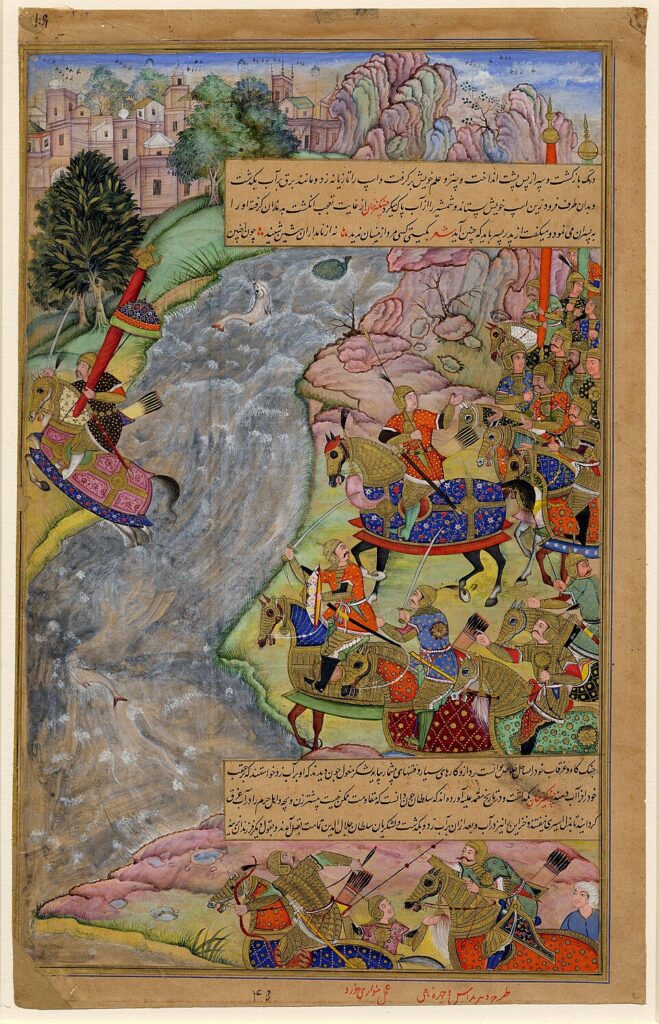
  • Phase 3: The Ghost Raids (Quick): Suddenly, 20,000 Mongol cavalrymen appeared out of nowhere. Led by General Jochi, they didn’t lay siege; they raided, burned border outposts, and vanished before the Sultan’s heavy infantry could even saddle their horses. The empire was now in a state of constant, panicked “Red Alert.”
  • Phase 4: The Killing Stroke (Quick): While the Sultan was frantically chasing shadows on the borders, Genghis Khan emerged from the “impossible” desert right in front of the gates of Bukhara. He wasn’t at the border; he was at the heart of the empire.

Why the Mongols Were Terrifyingly Effective

It wasn’t just strategy; it was their “tech” and lifestyle:

  • Infinite Mobility: Every Mongol soldier had 4 to 5 horses. They would swap mounts mid-gallop. This gave them the speed of a modern mechanized unit in the 13th century.
  • No Supply Lines: They didn’t need food wagons. They lived off the land and their herds. This meant they could move twice as fast as any other army on Earth.
  • The Silk Secret: They wore silk undershirts. If an arrow hit them, the silk wouldn’t break; it would wrap around the arrowhead. This allowed them to pull the arrow out cleanly, preventing the infections that killed most medieval soldiers.
  • Shock and Awe: Genghis used brutality as a marketing tool. If a city surrendered, they were often spared. If they resisted, the destruction was so absolute that the next city would surrender just by hearing the Mongols were coming.

The Odyssey: A Complete Guide to Homer’s Epic Tale of Heroism

Introduction

The Odyssey is one of the most famous adventure stories ever written. It was created by the Greek poet Homer.

The story is about a brave king named Odysseus.

  • He fought in the Trojan War for 10 years.
  • After the war ended, it took him another 10 years to return home.
  • So his journey lasted 20 years in total

Problems at Home

While Odysseus is trying to return home, things become difficult in his kingdom, Ithaca.

  • More than 100 men move into his palace.
  • These men are called suitors.
  • They want to marry his wife Penelope and become king.
  • They eat his food and spend his money.

But Penelope does not give up. She believes Odysseus will come back one day.

Three Big Challenges Odysseus Faced

1. The One-Eyed Giant

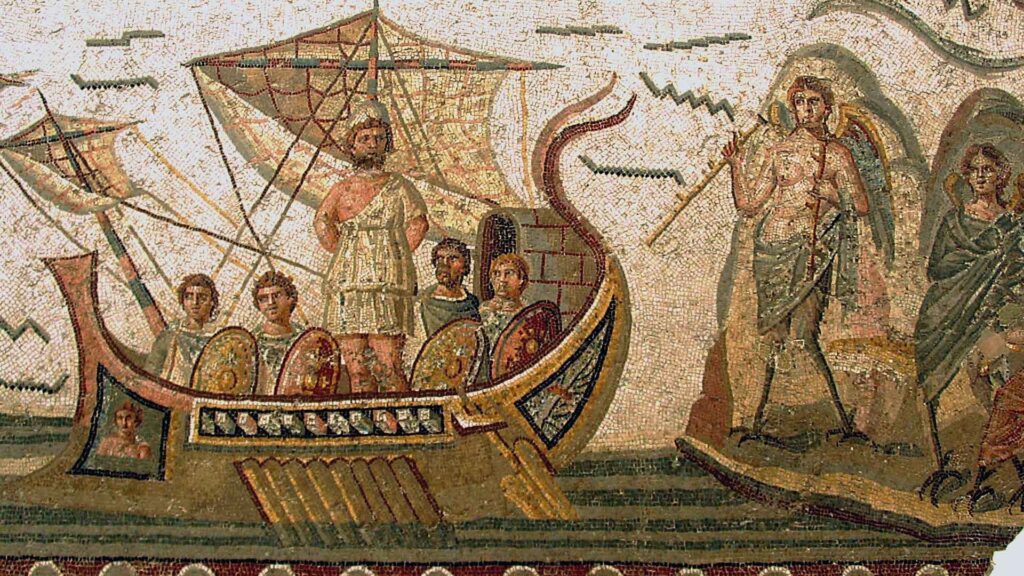
Odysseus meets a giant Cyclops named Polyphemus. The giant traps Odysseus and his men in a cave.

Odysseus uses a clever trick to escape. He blinds the giant and runs away. But Polyphemus is the son of Poseidon. Poseidon becomes very angry and creates storms to stop Odysseus from reaching home.

2. The Bag of Winds

A magical king gives Odysseus a bag full of powerful winds. The king tells him not to open it.

But while Odysseus is sleeping, his sailors think the bag contains treasure. They open it. Suddenly the winds escape and push the ship far away from home.

3. The Witch Circe

Odysseus meets a sorceress named Circe. She turns his men into pigs using magic!

Odysseus later saves them, and Circe becomes friendly. She tells him he must travel to the Underworld to learn the way home.

The Island of Calypso

Odysseus later becomes trapped on an island with a goddess named Calypso. She keeps him there for 7 years because she wants him to stay with her forever.

But Odysseus misses his family. Finally, the gods order Calypso to let him go.

Odysseus Finally Returns Home

When Odysseus reaches Ithaca, the goddess Athena helps him. She disguises him as a poor beggar so nobody recognizes him.

The Bow Contest

Penelope creates a challenge. She says she will marry the man who can:

  • String Odysseus’ huge bow
  • Shoot an arrow through 12 axe holes

All the suitors fail. But the beggar (Odysseus in disguise) easily completes the challenge.

The Final Victory

Odysseus reveals his true identity. With the help of his son Telemachus, he defeats the suitors and takes back his kingdom.

After 20 long years, Odysseus finally returns home to his family.

What This Story Teaches Us

People still love The Odyssey because it teaches important lessons:

  • Never give up, even when life is hard.
  • Use your brain, not just your strength.
  • Family is very important.

The Art of the “Lightning War”: How Blitzkrieg Changed Modern Warfare

If you’ve ever sat through a World War II documentary, you’ve almost certainly heard the term Blitzkrieg.

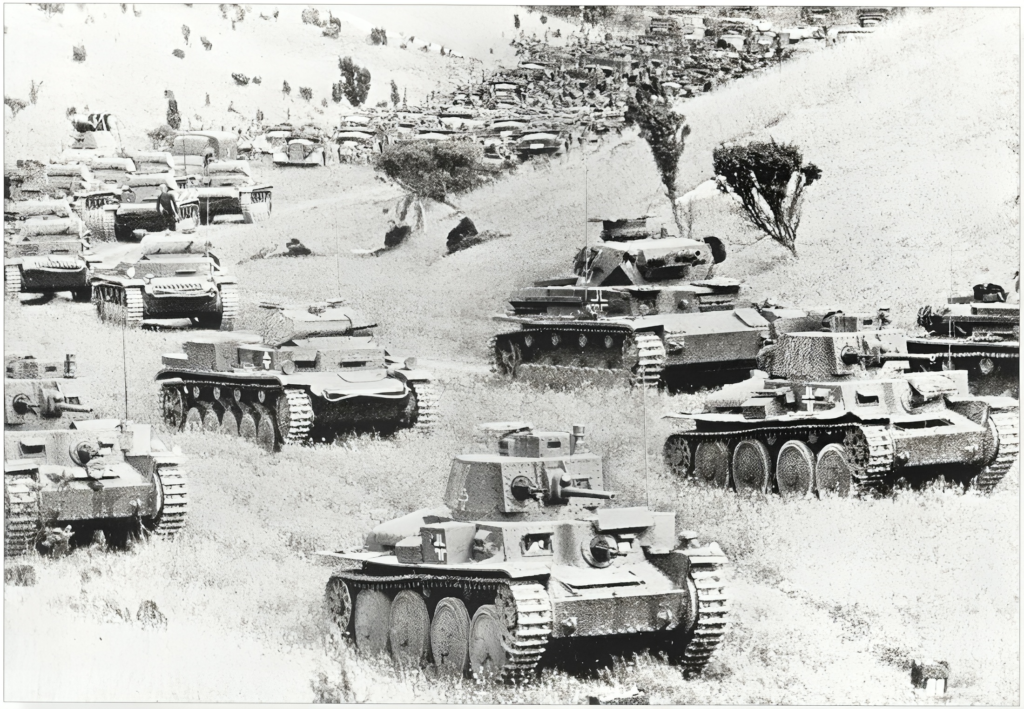
Literally translated as “Lightning War,” the word carries a certain cinematic weight. It’s usually invoked to describe the sheer terror of German Panzer divisions tearing across the European map at a speed that, at the time, seemed physically impossible. It wasn’t just a military tactic; it was a psychological shock to the system.

But where did this strategy come from? Was it a brand-new invention of the 1930s, or something much older? As it turns out, the roots of this “modern” warfare stretch back to the 18th century.

The Historical Blueprint

While we associate Blitzkrieg with Hitler’s generals, the foundation was actually laid by Frederick the Great of Prussia. A master military strategist, Frederick realized that raw power wasn’t everything; speed of movement was the ultimate advantage. He taught his armies to concentrate their forces at a single, precise point to overwhelm the enemy before they could react.

Fast forward to World War I: Germany found itself trapped in the slow, bloody stalemate of trench warfare. After the war, General Hans von Seeckt analyzed their defeat. His conclusion? Huge, massive armies are too slow to win. To achieve victory, an army needs to be small, elite, and incredibly mobile.

The Two Golden Rules of Blitzkrieg

The Blitzkrieg doctrine operates on two primary goals:

  1. Total Destruction of the Enemy: This isn’t just about winning a battle; it’s about annihilating the opposing force.
  2. Movement Warfare (Bewegungskrieg): You don’t fight standing still. You move rapidly to encircle the enemy (a tactic called Kesselschlacht). By surrounding them from all sides, you achieve total destruction.
The Secret Sauce: “Local Superiority”

One of the biggest misconceptions is that the Germans always had more tanks or men. In reality, they were often outnumbered. Their trick was Local Superiority.

Instead of spreading their forces thin over a long front line, they would find an individual weak point in the enemy’s defense. They would then lose 100 % of their robustness within a single bantam interval. Even if the enemy had 500 tanks and the Germans had only 100, if the Germans had placed every 100 tank against just 10 of the enemy’s second tank in that very spot, they would have won every single era.

The Role of Technology: Panzers and Radios

The Allies actually invented the tank, but the Germans perfected how to use it. While the French used tanks as “shields” for slow-moving foot soldiers, the Germans created Panzer Divisions. These were self-contained “ecosystems” of tanks, motorized infantry, and mobile artillery that could move at high speeds.

But the real game-changer wasn’t the gun-it was the Radio. Every German tank had high-quality communication systems. This allowed:

  • Real-time coordination between tanks.
  • Immediate calls for air support from the Luftwaffe.
  • The ability to change plans on the fly without waiting for orders from headquarters.
Mission Command: Freedom to Lead

Maybe the most modern human component in Blitzkrieg was Mission Command, (not Auftragstaktik). In the mainly military, the troops wait for a precise command from the pinnacle. In the German model, the best general stated his objective, but the military officer in the country had the freedom to decide how to achieve this. This flexibility meant that, if a tank commander saw an opportunity, he would take it immediately, and he would not wait for a telephone call from Berlin.

The Fall of France (1940)

We’ve seen the whole thing arrive together during the invasion of France. As the French waited to see their enormous Maginot Line fortification, the Germans saw a pause in the thicket of the Ardennes. They struck together with such speed and concentrated influence that the allied forces were circling before they even realized that the invasion had indeed begun.

Conclusion

Blitzkrieg wasn’t just about speed machines; it was a perfect union of the past, psychology, and technology. The German defense changed the face of battle forever by ranking speed, interaction, and decentralized direction