
Imagine an empire so vast that it stretched across modern-day Peru, Ecuador, Bolivia, Chile, Colombia, and Argentina. A highly developed civilization of over 10 million people, speaking dozens of languages, navigating complex mountain terrains, and hoarding unimaginable wealth.
Now, imagine that entire empire being brought to its knees by a tiny group of just 168 Spanish fighters.
It sounds like a fictional movie script, but it is one of the most staggering, brutal facts of human history. The fall of the Inca Empire is a masterclass in military technology, psychological warfare, and catastrophic political timing. Here is exactly how it happened.
1. A House Divided: The Inca Civil War
The Spanish did not conquer a stable empire; they walked into a nation bleeding from self-inflicted wounds.
In 1527, the Inca Emperor and his chosen heir both died suddenly from a mysterious illness (likely smallpox, which had begun spreading ahead of the Europeans). This triggered a catastrophic civil war between two royal brothers: Huáscar in the south and Atahualpa in the north.
After years of bloody conflict, Atahualpa finally won, capturing his brother and claiming the throne. But just as he was celebrating his victory, word reached him that a strange group of pale, bearded foreigners had landed on the coast.
2. Enter Francisco Pizarro: Driven by Envy
The leader of these foreigners was Francisco Pizarro, a Spanish conquistador. Pizarro wasn’t just looking for wealth; he was looking for fame. His cousin, Hernán Cortés, had recently conquered the Aztec Empire, becoming a legendary hero in Spain. Desperate to outdo his cousin, Pizarro secured financial backing from King Charles I of Spain for a high-stakes gamble into uncharted South American territory.
On his third expedition, Pizarro marched his small band of 168 men directly into the Andean highlands toward the city of Cajamarca, where the victorious Inca Emperor, Atahualpa, was currently resting.
3. The Fatal Meeting at Cajamarca (1532)
Atahualpa knew the Spanish were coming, but he wasn’t worried. Why would he be? He was surrounded by a battle-tested imperial army of tens of thousands. To him, 168 men were a minor curiosity, not a threat.
On November 15, 1532, Pizarro arrived in the city square of Cajamarca and sent an envoy on horseback to request a meeting. The Incas had never seen horses before-animals that had been extinct in the Americas for 10,000 years. The Spanish messenger rode furiously toward Atahualpa, stopping the massive beast inches from the emperor’s face to terrify him. While his attendants panicked, Atahualpa sat entirely motionless, refusing to show fear. He agreed to meet Pizarro the next day.
It was a fatal mistake. Pizarro spent the night hiding his men, his cavalry, and four small cannons inside the buildings surrounding the open courtyard.
4. The Trap: A Bible and a Bloodbath
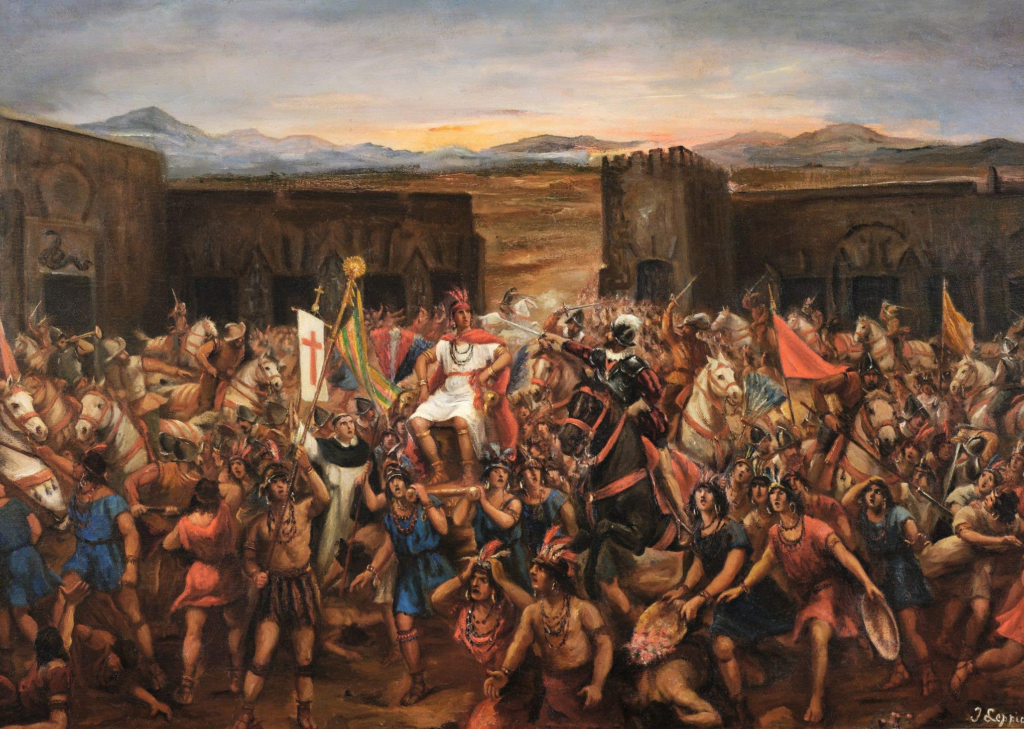
On the evening of November 16, Atahualpa entered the square on a golden litter, surrounded by thousands of his top nobles and citizens. Because this was a peaceful meeting, his guard carried only ceremonial, hidden weapons. They expected a diplomatic talk; they walked into a slaughterhouse.
A Spanish priest stepped forward, holding a Christian Bible, and began speaking to the Emperor about a foreign god. Having no concept of a written book or a printing system, Atahualpa examined the object briefly before tossing it to the ground.
Pizarro used this moment of “sacrilege” as the ultimate trigger. He ordered his men to attack.
The Tactics of “Shock and Awe“
- The Cannons Roared: The sudden, deafening explosions of hidden cannons ripped through the crowd. The Incas had never heard gunpowder before-it sounded like the sky was collapsing.
- The Armored Monsters Charged: Steel-clad Spanish riders burst from the buildings on horseback. To the terrified Incas, the armor-clad rider and the horse looked like a single, unstoppable, mythological monster.
- The Steel Sliced: The Incas fought back bravely with their hands and wooden clubs, but they were utterly useless against Spanish steel swords and metal breastplates.
Within a few hours, the 168 Spanish soldiers slaughtered thousands of Inca nobles without losing a single Spanish life. By nightfall, Emperor Atahualpa was a prisoner in his own empire.
5. The Ultimate Betrayal
Realizing that the Spanish had an insatiable lust for gold, Atahualpa made a desperate play for his life. He offered Pizarro a staggering ransom: he promised to fill his entire prison cell with gold, and two adjacent rooms with silver, in exchange for his freedom.
Pizarro eagerly agreed to the deal.
For eight long months, treasure poured into Cajamarca from the furthest corners of the empire. Even though their king was locked away, the Inca citizens obeyed his orders implicitly because they viewed him as a living god.
But once the rooms were filled with unimaginable wealth, Pizarro broke his word. Paranoid that an Inca army was secretly marching to rescue the Emperor, Pizarro put Atahualpa on a mock trial for treason. The emperor was given an ultimatum: burn alive at the stake, or convert to Christianity and face a “merciful” execution. Atahualpa accepted baptism and was promptly strangled to death.
6. The Takeaway: How Did the Impossible Happen?
The fall of the Inca Empire wasn’t just a victory of men; it was a victory of technology and isolation.
The Spanish possessed four distinct advantages: gunpowder, steel weaponry, metal armor, and horses. The Incas, isolated from the rest of the world for millennia, had never developed the metallurgy required to fight steel, nor had they ever seen cavalry. Combined with the psychological terror of Pizarro’s ambush, the Inca forces were completely paralyzed by what modern military strategists call “shock and awe.”
Pizarro’s ruthless campaign shattered an empire and laid the groundwork for centuries of Spanish rule, permanently altering the language, culture, and geography of South America forever.